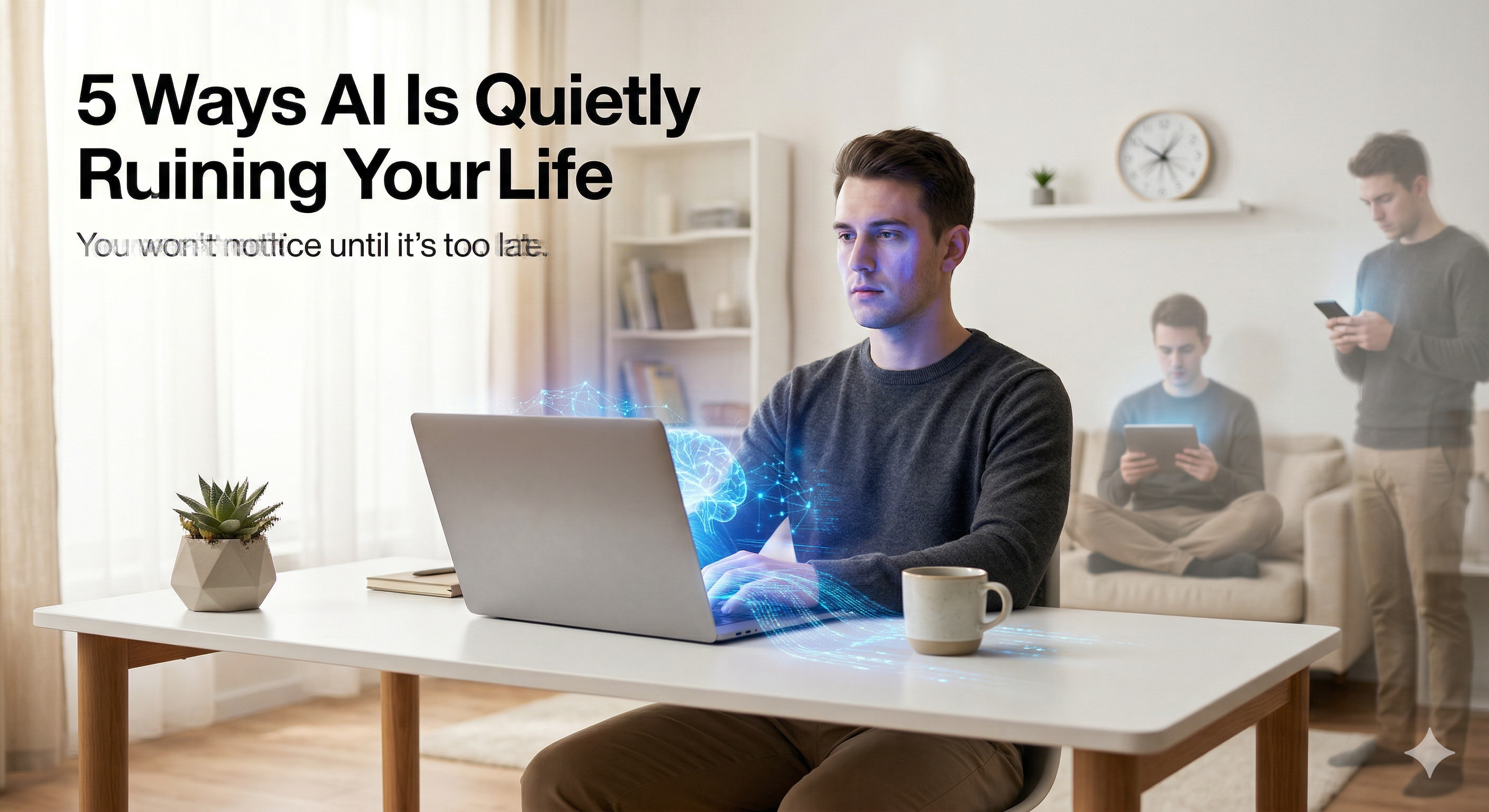
5 Ways AI Is Quietly Ruining a Perfectly Good Life
Nobody comes to tell you.
There's no warning label. No pop-up that says "Hey — this tool is going to rewire how you think, break your focus, wreck your dinner conversations, and make you question whether you're smart enough to exist in 2025."
You just.. start using it. And it's good. It's really, really good.
I'm Sachin Rajgire, Founder and CEO of Wynisco Inc. — a US tech job placement company that has helped 300+ international professionals land roles averaging $95K. We run fast here. Speed is part of the job. So when Anthropic Claude Code, Claude Cowork, and Claude Chat showed up promising to make everything faster — I went all in.
Thirty days. Every single day. No weekends off.
And the tools delivered. I'm not going to pretend they didn't.
But here's what also happened — quietly, slowly, without announcing itself: something broke. Five somethings, actually.
This is that post.
The Problem With AI Is That It Works
Most cautionary tech stories follow the same arc. The thing overpromises. It underdelivers. You feel silly for believing the hype. You move on.
That's not this story.
The problem with AI — the real problem — is that it works. Genuinely, impressively, sometimes jaw-droppingly well. And that's exactly what makes it dangerous in ways that are hard to see until you're already inside them.
When a tool fails, you notice. You adjust. You stop.
When a tool works better than expected, you lean in harder. You open more tabs. You give it bigger tasks. You start building your entire workflow around it.
And somewhere in that leaning-in, something quietly shifts. Not all at once. Not dramatically. Just.. slowly. Over 30 days.
Here are the 5 things that shifted for me.
1. Your Sense of Speed Gets Permanently Broken
Day 1: AI writes a first draft in 40 seconds. You're amazed.
Day 7: 40 seconds feels normal.
Day 15: You're annoyed it took 40 seconds. Couldn't it have been 20?
This is the first quiet casualty — your baseline for what "fast" means.
AI compresses time so effectively in certain areas that your brain recalibrates everything. Meetings feel criminal. Approvals feel slow. Conversations that used to be just conversations now feel like bottlenecks.
Before AI, finishing a complex task in two hours felt fine. After two weeks of AI, finishing in two hours feels like you failed.
The bar moves. And you're the one moving it — without realising it — every single time AI beats your last expectation.
What breaks isn't your productivity. It's your ability to feel satisfied with any pace that isn't instant. And dissatisfaction at that frequency is exhausting.
We want AI tools to go to the moon and come back before lunch. That expectation doesn't stay inside your laptop. It bleeds into everything.
2. FOMO Becomes a Full-Time Job
There is always a newer tool.
Always something that can supposedly do more, faster, better, cheaper than whatever you're currently using. And the new one dropped last Thursday. And you haven't looked at it yet.
That thought — am I using an inferior tool? — starts small. A passing question while scrolling LinkedIn. A YouTube thumbnail you didn't click. A mention in a Slack group.
By week two, it's background noise you can't turn off.
Am I spending three hours on something a different tool does in eight minutes? Is there a workflow someone built over the weekend that makes my entire current process obsolete? Am I the last person to find out about the tool everyone is already calling essential?
FOMO in the AI era isn't like regular FOMO. Regular FOMO is about events — parties you missed, trips you didn't take. It fades.
AI FOMO is about capability. The nagging feeling that while you were doing the work, someone else was building the tool that makes the work irrelevant. It doesn't fade. It refreshes weekly.
New tools drop constantly. New demos. New "this changes everything" posts. New tutorials from people who figured it out three days before you.
Keeping up with the tools has become a second job. Meanwhile the actual job still needs doing.
3. Deep Work Quietly Disappears
This one is the most dangerous — because it feels like productivity right up until the moment you realise it isn't.
Within two weeks, I had developed a habit I didn't consciously choose: open a tab, assign a task, open another tab, assign another task, check the first tab, redirect it, open a third tab.
Four to six parallel workstreams at any given moment. Feels efficient. Isn't.
Here is what's actually happening: you are working all day and getting tasks done — not actual work done.
Tasks are reactive. Work is generative. Tasks clear the to-do list. Work builds something that matters.
Deep work — the kind where you are locked in for 90 uninterrupted minutes, thinking through a hard problem, building something real — that disappeared. Replaced by a dopamine loop of opening tabs, checking outputs, approving, adjusting, reopening.
You're compelled to check constantly. Does this need my input? Did that finish? Why did this stop? Should I redirect it?
You feel productive every minute of the day. And at the end of the day, you can't quite name what you actually built.
I miss being bored. That sounds absurd. But boredom used to be the entry point to my best thinking. Thirty days of AI removed every gap where that thinking used to live.
4. Self-Doubt Shows Up Uninvited
Everyone on social media is running complex automations.
Seventeen-step n8n workflows connecting a dozen apps. AI agents that respond to emails, update databases, draft contracts, brief the team, and apparently also meal-plan. (Only slightly exaggerating.)
And there you are. Typing something manually into Google Docs.
The self-doubt that arrives in week three is not loud. It doesn't announce itself. It just quietly settles in.
Am I stupid? Not technical enough? Too old to learn this? Too lazy to figure it out? Some combination of all of the above?
Here is what nobody tells you: the people posting those 40-second demos spent 40 hours building them. The workflow that looks seamless broke seventeen times before it worked once. The automation that seems effortless required three failed attempts, two YouTube tutorials, and one very long conversation with a support forum.
You're comparing your behind-the-scenes to their highlight reel.
That comparison will lose every time. Not because you're falling behind — but because the frame is dishonest. Progress in AI is not linear and it is not uniform. Everyone is figuring it out in real time, including the people making it look easy.
The self-doubt is a side effect of seeing polished outputs without seeing the mess that produced them. Don't let it stick.
5. It Follows You Home
My wife does not want to hear about another AI tool.
I said this sentence out loud recently and even I heard how it sounded.
But it's not just at home. At a recent gathering — old friends, the kind who returned to India around the same time I did — we sat down for a nice evening together. Good food. Good company.
Ten minutes in, someone said: "What new AI tool are you trying?"
Nobody asked about the kids first. Nobody asked about work in the old sense. The opening question, the social currency, the thing that signals you're paying attention — it's all AI now.
We are, collectively, a little cooked.
The tools follow you to the dinner table, into the weekend, into conversations that used to be a break from all of it. Your brain doesn't switch off because the tools are always on — and always improving — and there is always something new to think about.
A peaceful Saturday used to mean tennis in the morning, family in the afternoon, maybe a film at night.
Now it means tennis in the morning, checking whether the workflow I set up on Friday is still running, and then feeling guilty that I'm checking on a Saturday.
AI doesn't clock out. That's a feature. It's also, quietly, the problem.
So Why Am I Still Using It?
Because despite everything above — the broken baseline, the FOMO, the shallow work, the self-doubt, the lost Saturdays — the tools are changing what is possible.
At Wynisco Inc., we help international students and immigrants navigate one of the hardest transitions of their lives: finding a job in the United States. 52 days average placement. $95K average salary. 300+ professionals placed and counting.
That work takes speed, precision, and a lot of human judgment. AI is accelerating the parts that can go faster. Which creates more room for the parts that need a human — the conversations, the strategy, the moments when a candidate needs someone genuinely in their corner.
That's not a small thing. That's the whole thing.
So yes. AI is quietly ruining a perfectly good life.
I'm not stopping.
But I'm going in with my eyes open now. And I think you should too.
The 5 Quiet Casualties — At a Glance
# | What Broke | How It Happens |
|---|---|---|
1 | Your sense of speed | Every win resets your baseline higher |
2 | Your peace of mind | FOMO never fully switches off |
3 | Your deep work | Tab-switching replaces real thinking |
4 | Your confidence | Polished demos hide messy realities |
5 | Your time off | The tools don't clock out and neither do you |
Which One Hit You Hardest?
If you've been using AI tools seriously — for work, for your business, for your job search — you've probably felt at least one of these.
Drop a comment. Which of the 5 broke first for you?
And if you're a job seeker using AI to sharpen your search, get placed faster, or navigate the US market — that's exactly what we do at Wynisco Inc. Reach out.
Sachin Rajgire is the Founder & CEO of Wynisco Inc., a US tech job placement company that has helped 300+ international professionals land roles averaging $95K in 52 days. Follow him on LinkedIn or join the newsletter at lnsignup.wynisco.com.
Written by
Sachin Rajgire