Forward Deployed Engineer: The Hottest Tech Role of 2026 — and How To Land One - Quick Answer
A Forward Deployed Engineer (FDE) is a hybrid technical role where one engineer sits inside a customer's office, observes the actual workflow, and ships AI-powered solutions in days instead of months. In 2026, FDEs are the most in-demand role at companies like Anthropic, OpenAI, Palantir, and Google Cloud, with starting comp running 30–50% above standard software engineer bands. Wynisco places engineers into FDE roles in an average of 52 days.
TL;DR — Key Takeaways
The Forward Deployed Engineer (FDE) role is the rebranded, AI-era version of the Technical Solutions Engineer.
Demand is exploding because AI coding tools collapsed a 6-month delivery loop into a 5-day loop.
The role requires three things: technical depth, customer fluency, and tact under pressure.
The fastest entry paths are Solutions Engineering, full-stack with strong soft skills, and Customer Success Engineering.
90 days of focused work is enough to reposition for the role.
Wynisco places candidates at a 78% placement rate, 52-day average, $95K average starting salary.
How to Pivot Into a Forward Deployed Engineer Role in 2026
The CEO of Google Cloud, Thomas Kurian, is posting Forward Deployed Engineer (FDE) job openings on LinkedIn. Himself. Not the recruiter. Not the hiring manager. The CEO.
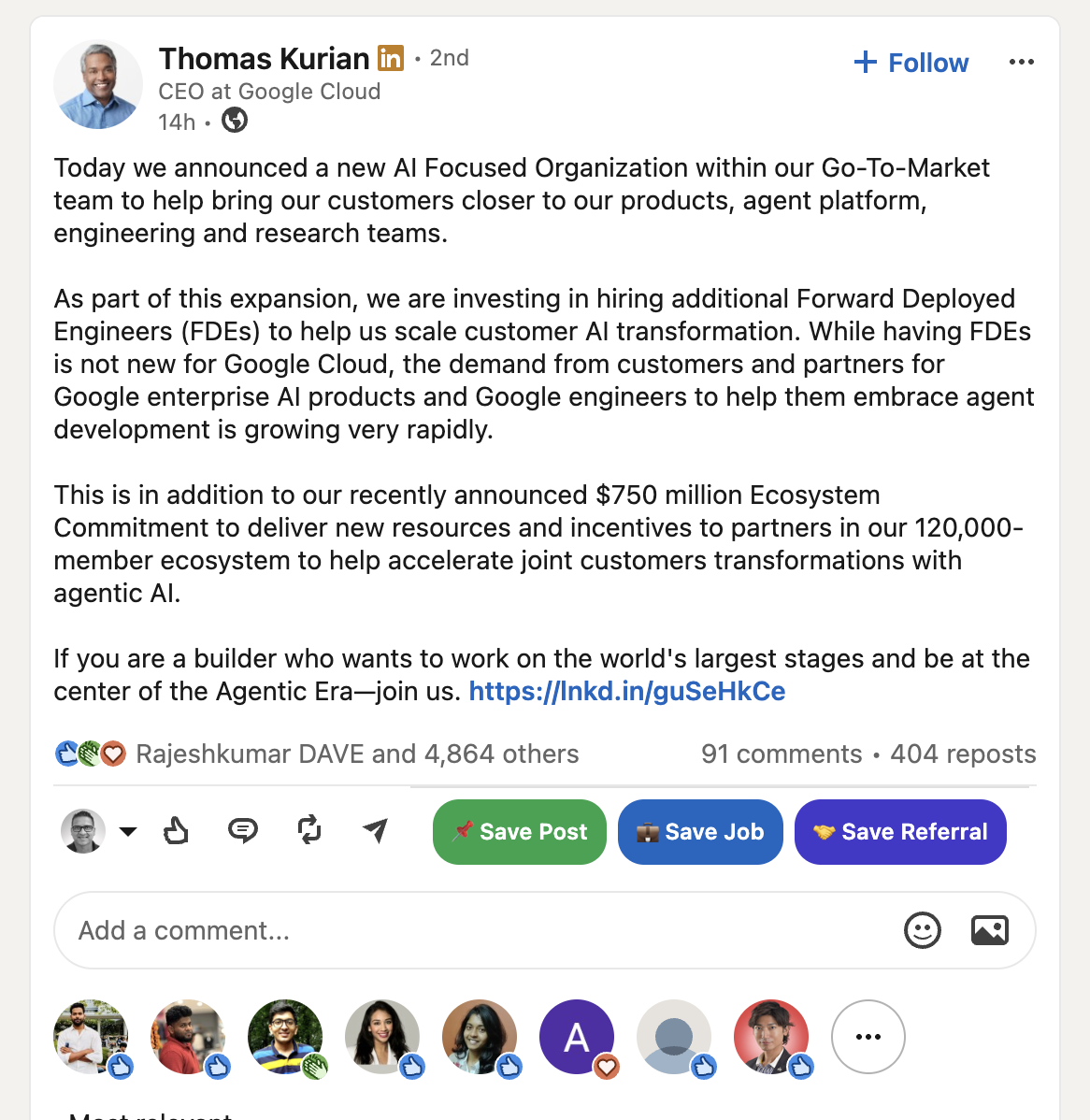
When a Fortune-100 chief executive starts doing the recruiter’s job in public, you can read it one of two ways. Either it’s branding theater — or the talent pool is so thin that the person at the top has decided to lend his face to the search. Look at how many openings he posted, and which other companies (Palantir, OpenAI, Anthropic, every major foundation-model startup) are running the same play, and the answer is obvious.
FDE is going to be one of the most-fought-over titles in tech for the next three years. Comp bands are already creeping above standard SWE. Candidates with the right blend of skills are getting two or three offers inside a month.
This piece is for engineers — Solutions Engineers, full-stack devs, ML engineers, platform engineers, anyone within reach of the role — who want to position themselves for it before the LinkedIn posts dry up.
First, what is a Forward Deployed Engineer, actually?
Strip the marketing language and FDE is a Technical Solutions Engineer.
That’s it. Same wine, different bottle.
The reason the new bottle matters is the loop:
The old Solutions Engineer loop
Solutions Engineer talks to the customer.
Goes back to engineering.
Engineering builds something.
Demo.
Customer says, “Actually, I wanted this instead.”
Everyone gets a little more annoyed.
Back to engineering. Repeat.
The new Forward Deployed Engineer loop
FDE sits inside the customer’s office (or virtually embedded with their team).
Observes the actual workflow — not the deck version of it.
Builds the fix using AI tooling right there, in front of the customer or within a day.
Demos same week. Ships same week.
The cycle compressed from quarters into days. That’s the entire innovation. Foundation models and AI coding assistants made it possible for one person — embedded inside the customer’s context — to do what used to take a four-person engineering team and a project manager.
Why the comp is higher
A Forward Deployed Engineer is doing three jobs that used to be split:
Solutions architect (understands the customer’s problem)
Software engineer (writes the actual code)
Customer success (keeps the relationship intact)
You’re being paid for the compression. The companies are still saving money compared to a four-person team that takes six months — but each individual FDE gets a salary that reflects the leverage they’re producing.
Who actually fits the role?
This is the part most posts get wrong. FDE is not a fit for every strong engineer.
You need to be three things at once.
Technical. You can read a customer’s stack, identify the bottleneck, and write working code — usually in TypeScript, Python, or whatever the customer’s team writes in. AI tools help, but you still need to read what the AI generates and know when it’s wrong.
Curious about other people’s businesses. A great FDE walks into a logistics company and within a week understands how the dispatcher actually plans routes. Bad FDEs build technically perfect features that solve the wrong problem.
Sweet-spoken. This is the one that filters most engineers out. If you bristle when a customer changes their mind, or if your default mode in meetings is “well, actually” — FDE is not for you. You will get walked out the door. The only people who get a pass on the people skills are the engineers who are so undeniably brilliant that customers tolerate them. That is a tiny club. Plan to be in the larger club.
The skillset to build now
Here is the rebuild, sequenced.
1. Sharpen the AI-native engineering loop
The advantage an FDE has over a 2018 Solutions Engineer is AI. You need to be fluent.
Use Claude, Cursor, Windsurf or an equivalent every day for code. Not occasionally. Daily.
Learn to write good prompts and good acceptance tests. Pair every AI-generated chunk of code with a test or a quick manual verification.
Get comfortable with at least one agentic framework (LangGraph, CrewAI, or just well-orchestrated tool calling).
Build two or three small projects end to end where you are the only engineer.
The metric: how fast can you take a problem statement to a working demo? Aim for hours, not days.
2. Re-learn how to listen
This is a soft skill, but it shows up in interviews. FDE hiring managers will ask you about a recent customer or stakeholder conversation. They want to hear that you listened, understood the actual problem, and changed your mind based on what you heard.
Practical drill: in your current role, spend one week asking three open questions for every one statement you make in customer or stakeholder meetings. Notice what changes.
3. Pick a domain or two
FDEs who specialize get paid more. Pick an industry — fintech, biotech, legal tech, climate, logistics — and read the trade press for sixty days. You don’t need a PhD. You need to be able to walk into a meeting and not look completely foreign.
4. Build a “deployed in production” portfolio
Forget the LeetCode grind. Build two or three things that real users use. Even ten users counts. Get a screenshot of the dashboard. Write up the architecture decisions. Put it on your site.
That portfolio is your interview.
5. Get fluent in customer-facing artefacts
A Forward Deployed Engineer writes design docs, demo scripts, and Loom walkthroughs almost as often as they write code. If your current role lets you draft one of these every two weeks, take it. If it doesn’t, simulate it on your portfolio projects.
6. Build the room-reading muscle
Practice articulating disagreement without making the other person defensive. Read Crucial Conversations or Never Split the Difference. This is the single biggest differentiator between a “great engineer” and a “great FDE.”
Where do you transition from?
The clearest paths into FDE roles, in rough order of how easy the jump is:
Solutions Engineer / Sales Engineer. You already do most of the job. You need to deepen the coding side and learn AI tooling.
Full-stack engineer with strong soft skills. You can build anything. You need to learn how to be customer-facing without flinching.
Customer Success Engineer. You already have the empathy. You need to deepen the engineering side substantially.
Consultant (Big 4 / boutique). You have the client muscle. You need the AI-native engineering loop.
Backend or platform engineer. Longest jump. You’ll need both the customer skills and the front-end fluency.
The interview pattern to expect
FDE interviews are usually four stages:
Recruiter screen.
Take-home or live coding — usually building something against a real API, not LeetCode.
Customer simulation — you walk into a fake meeting with a “customer” played by an interviewer and you have to scope a solution live.
Architecture discussion plus team fit.
Stage three is where most strong coders fail. Prepare for it specifically.
A word of caution
FDE is hot, which means every engineer on LinkedIn is suddenly going to claim they are one. Hiring managers know this. The signal that survives is: a portfolio of things you shipped end-to-end, a track record of customer-facing work, and a calm presence in a room of stakeholders.
That signal takes ninety days to build. Start now and you’ll be ready before the cycle peaks.
This piece was written by the Wynisco team. Wynisco runs a Job-Search-as-a-Service for engineers and immigrants in the US — 78% placement rate, average 52 days to placement, average salary $95K. If you’re an engineer thinking about an FDE pivot, reach out: sachin@wynisco.com or wynisco.com.
Frequently Asked Questions
What does a Forward Deployed Engineer do?
A Forward Deployed Engineer (FDE) works on-site with a customer to design, build, and ship AI-powered solutions inside the customer’s actual workflow. Unlike traditional sales engineers, FDEs write production code, make architectural decisions, and own delivery end-to-end — typically in 5–10 day cycles instead of 6-month enterprise software timelines.
How much does a Forward Deployed Engineer make in 2026?
Forward Deployed Engineer compensation in 2026 typically ranges from $180K to $400K total comp at frontier AI companies like Anthropic, OpenAI, and Palantir, with senior FDEs at top labs clearing $500K. Wynisco’s placement data shows $95K average starting salary across all engineering roles, with FDE placements running significantly higher.
Is Forward Deployed Engineer the same as Solutions Engineer?
Forward Deployed Engineer is the AI-era evolution of the Technical Solutions Engineer role. The job description is nearly identical — what changed is that AI coding tools compressed the customer-feedback loop from six months to five days, which is why FDE compensation has moved 30–50% above traditional Solutions Engineer bands.
What companies are hiring Forward Deployed Engineers right now?
The biggest FDE hirers in 2026 are frontier AI labs (Anthropic, OpenAI, Cohere), data-platform companies (Palantir, Scale AI), cloud providers (Google Cloud, AWS), and well-funded AI-native startups in vertical SaaS. Many CEOs at these companies — including the CEO of Google Cloud — are posting FDE openings directly on LinkedIn.
How long does it take to become a Forward Deployed Engineer?
A working software engineer with 2+ years of experience can reposition for a Forward Deployed Engineer role in roughly 90 days. Wynisco’s playbook sequences this rebuild across six skill blocks: AI-native engineering loop, customer fluency, domain depth, deployed portfolio, systems fundamentals, and soft-skill muscle.
Do you need a CS degree to be a Forward Deployed Engineer?
No, a computer science degree is not required to be a Forward Deployed Engineer. What matters is the ability to ship working code with AI tools, read unfamiliar codebases, and hold a technical conversation with a customer without bruising their ego. Many top FDEs are self-taught engineers or former consultants.
What’s the interview process for a Forward Deployed Engineer role?
The FDE interview is almost always four stages: a recruiter screen, a take-home built against a real API (not LeetCode), a live customer simulation where an interviewer role-plays a difficult enterprise client, and a final architecture and team-fit conversation. The customer simulation is the stage that filters out pure coders.
What’s the difference between an FDE and a Customer Success Engineer?
A Customer Success Engineer is reactive — they answer tickets, debug integrations, and unblock existing customers. A Forward Deployed Engineer is proactive and embedded — they sit inside the customer’s office, scope new solutions, write production code, and own delivery. FDEs are paid more because they generate revenue, not just retain it.
Can a backend engineer transition to a Forward Deployed Engineer role?
Yes, backend and platform engineers can transition into Forward Deployed Engineer roles, but it’s the longest jump of any engineering path. The technical skills carry over directly. The gap to close is customer fluency, demo storytelling, and operating under live pressure — usually 90 days of deliberate practice.
What AI tools should a Forward Deployed Engineer use daily?
Working FDEs in 2026 use Claude or Claude Code for spec-to-code work, Cursor or Windsurf for in-editor pairing, and at least one agentic framework (LangGraph, Mastra, or vendor-native agent SDKs). The bar isn’t tool count — it’s how fast you can take a problem statement to a working demo in a customer’s stack.
How does Wynisco help engineers land Forward Deployed Engineer roles?
Wynisco runs hands-on placement, not a course. The team works with engineers on the AI-native engineering loop, customer fluency, deployed-in-production portfolio, interview prep, and outbound to hiring managers at AI startups and Fortune 500 enterprise teams. Wynisco’s placement rate is 78% with a 52-day average time to placement.
Is Forward Deployed Engineer a real long-term career path?
Yes. Forward Deployed Engineer is a durable career path that mirrors Solutions Architecture and Sales Engineering — both of which have existed for 20+ years. The AI era simply increased the leverage of the role. Strong FDEs can move into engineering management, product, founding-engineer roles, or start their own AI consultancies.
About the author
Sachin Rajgire is the founder of Wynisco Inc., a Job-Search-as-a-Service company that places engineers and immigrant professionals into roles at AI startups and Fortune 500 teams across the US. He writes weekly on engineering hiring, the FDE role, and the H-1B / OPT career landscape for international tech talent.
Wynisco placement data (2026): 78% placement rate · 52-day average time to placement · $95K average starting salary.
Follow Sachin on LinkedIn · Read more on the Wynisco blog · Apply for placement at wynisco.com/apply.
Written by
Sachin Rajgire