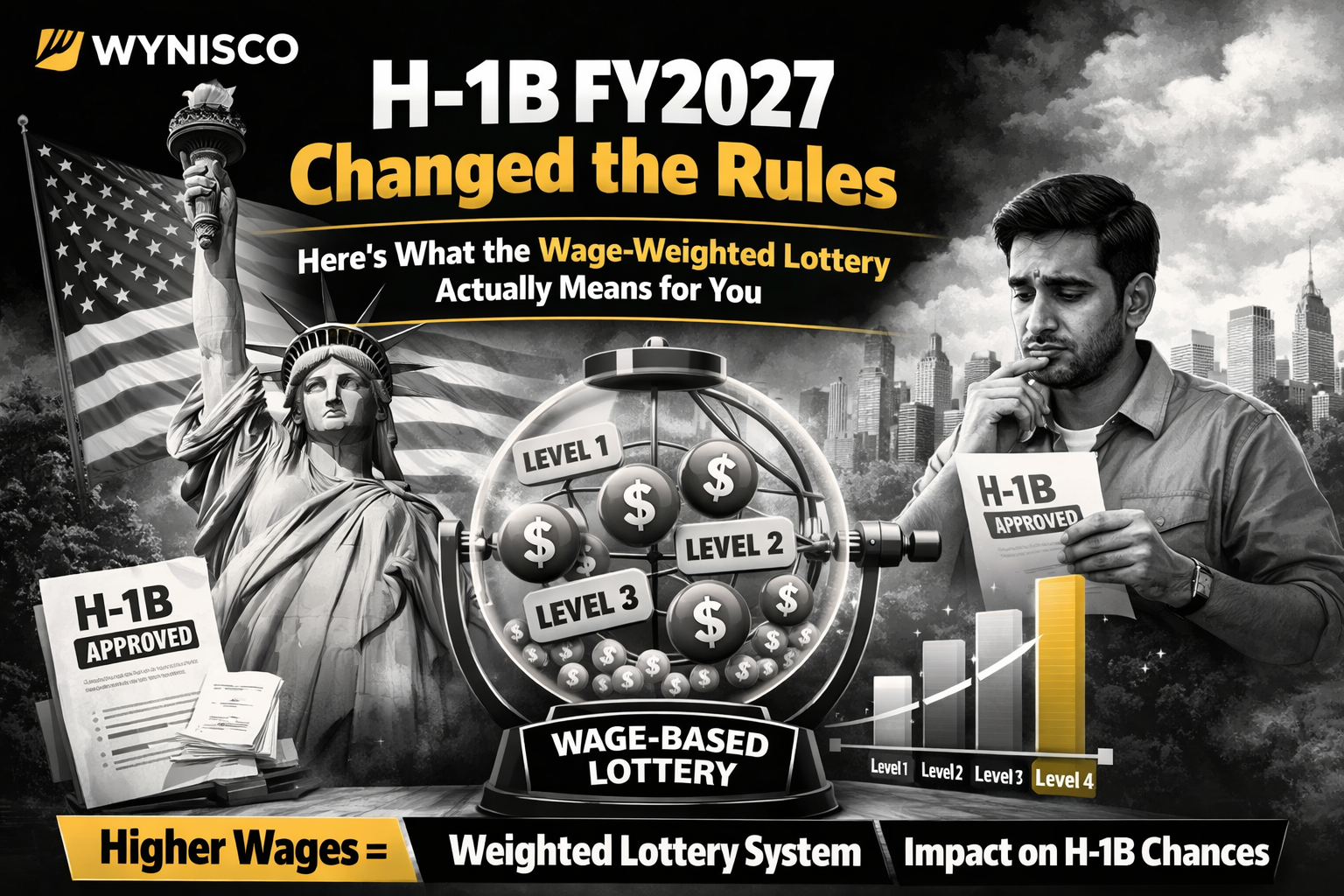
Question: How does the H-1B FY2027 wage-weighted lottery work?
Answer: Starting FY2027, USCIS replaced the random H-1B lottery with a wage-weighted selection system effective February 27, 2026. Each registration receives entries based on the DOL prevailing wage level for the role: Level I = 1 entry (15.29% selection odds), Level II = 2 entries (30.58%), Level III = 3 entries (45.87%), Level IV = 4 entries (61.16%). Higher salary = more entries = better odds. Entry-level candidates now face 4x worse odds than senior-level candidates. If you're re-entering FY2028, your salary negotiation is now immigration strategy. Wynisco Inc., founded by Sachin Rajgire, helps international professionals find roles at the right salary level to improve their H-1B odds and stay employed in the US.
The H-1B lottery you knew is over.
For years, every candidate had the same odds. One registration, one equal chance. Random draw. Pure luck.
That changed on February 27, 2026.
Wynisco Inc. founder Sachin Rajgire has spent 8 years watching international professionals navigate this system. FY2027 is the biggest structural change to the H-1B in years — and most candidates still don't fully understand what happened to their odds.
This blog breaks it down. No legal jargon. No hedging. Just the math.
What Changed: The Old System vs. The New System
Old system (every year before FY2027): Every eligible registration had exactly one entry in the selection pool. Pure random draw. A candidate offered $60,000 had the same odds as one offered $150,000. Same role level, same location — didn't matter. One ticket each.
New system (FY2027 onwards): USCIS now assigns multiple entries per registration based on the DOL Occupational Employment and Wage Statistics (OEWS) prevailing wage level for the offered role in the offered location.
The entry count works like this:
Wage Level | Who This Covers | Entries in Pool |
|---|---|---|
Level I | Entry-level, limited experience | 1 entry |
Level II | Some experience, routine tasks | 2 entries |
Level III | Experienced, complex tasks | 3 entries |
Level IV | Highly experienced, senior roles | 4 entries |
This is not a marginal difference. A Level IV candidate has 4x the entries of a Level I candidate. That is not "slightly better odds." That is a fundamentally different game.
The rule was published in the Federal Register on December 29, 2025, became effective February 27, 2026, and applies to FY2027 — the cycle that just closed March 19, 2026.
The Actual Numbers: What DHS Projects Will Happen
Here is what most articles won't show you. DHS published official probability estimates for each wage level under the new system.
Under the old system, every registrant had the same selection odds: 29.59% average across all levels.
Under the new wage-weighted system, those odds split dramatically:
Wage Level | Old Odds | New Odds (DHS Estimate) |
|---|---|---|
Level I | 29.59% | 15.29% |
Level II | 29.59% | 30.58% |
Level III | 29.59% | 45.87% |
Level IV | 29.59% | 61.16% |
Let that sink in.
If you were registered at Level I — your odds dropped from roughly 1 in 3 to roughly 1 in 7.
If you were registered at Level IV — your odds jumped from 1 in 3 to more than 3 in 5.
Some independent analysis suggests the Level I drop could be even steeper than DHS's estimates, potentially falling below 15%. The direction is clear regardless of the exact number: entry-level candidates got hit hard.
What Determines Your Wage Level
Wage level is not set by what you negotiate with your employer. It is determined by the Department of Labor's OEWS prevailing wage data for your specific role and location.
Four factors determine which level applies to your registration:
1. Your SOC code (Standard Occupational Classification) This is the occupational category USCIS uses to look up prevailing wage data. A Software Developer, a Data Engineer, and a QA Analyst all have different SOC codes — and different prevailing wage thresholds.
2. Your area of intended employment A Software Developer role in San Francisco has a much higher Level I threshold than the same role in a mid-sized city in Ohio. Location changes the benchmark.
3. Your actual offered salary Your salary is compared against the OEWS thresholds for your SOC code and location. If your offered salary falls below the Level II threshold — you're at Level I regardless of what your employer calls the role.
4. Multiple work locations If your role involves working at multiple locations — hybrid, travelling, or multi-site — USCIS will assign you to the lowest wage level across all locations. If one work location brings your level down, that is the level that counts. There is no averaging.
One more critical rule: if multiple employers submit registrations for the same candidate, USCIS assigns the candidate to the lowest wage level among all registrations. More registrations don't help if they drag your level down.
The Question Most Candidates Haven't Asked
Do you know what wage level your employer registered you at?
Most don't. That's the honest answer.
Many candidates found out after March 19 — after the window closed — that their employer registered them at Level I or Level II. They assumed a good salary meant a strong registration. But "good" is relative to the DOL threshold for that role in that location.
Here's what you should have asked — and what to ask before FY2028:
What SOC code did you use for my registration?
What area of intended employment did you designate?
What OEWS wage level did my offered salary correspond to?
Did you register me at multiple locations? If so, what level was assigned?
These are not unreasonable questions. They are the difference between entering FY2028 with 1 entry or 4.
What This Means for FY2028 Re-Entry
If you were not selected in FY2027, you can re-enter the FY2028 lottery — which opens in March 2027.
Under the new system, re-entry strategy is no longer just about finding another willing sponsor. It is about the intersection of salary, role, and location.
Three things to do now — before FY2028 registration opens:
1. Negotiate your salary with the wage level framework in mind. Ask your employer or future employer what OEWS level your offered salary corresponds to for your specific SOC code and location. If you are currently at Level II and a salary increase would push you to Level III, that is not just a pay raise — it doubles your lottery entries. That context changes the salary negotiation entirely.
2. Consider location strategically. The same salary that qualifies for Level III in one city may only qualify for Level II in a higher cost-of-living metro. If you have flexibility on work location, and your employer is open to it, the DOL prevailing wage data for your SOC code across different metros is worth reviewing.
3. Start this conversation in January 2027. Not February. Not March. January. Registration windows open fast, and late corrections to wage level or SOC code create compliance risk. The conversation with your employer needs to happen before the registration window — not during it.
A Note on the $100,000 Fee
This was introduced separately from the wage-weighted rule, but it matters for the same people.
A Presidential Proclamation issued September 21, 2025 introduced an additional $100,000 payment requirement for certain new H-1B petitions. This applies to cap-subject petitions requiring consular processing for beneficiaries currently outside the United States.
It does not apply to H-1B extensions, amendments, transfers, or cap-exempt filings.
If you are currently on OPT inside the US — this fee does not apply to your petition if selected. If you are applying from outside the US and require consular processing, your employer needs to budget for this.
What Wynisco Watches For
At Wynisco Inc., we don't do visas or legal filings. We find jobs.
But the wage-weighted system changes the job search itself for international professionals.
A role that keeps you employed matters more than it used to. The right salary at the right level with the right employer is now part of the H-1B strategy — not separate from it.
The candidates who entered FY2027 at Level III or IV didn't just get lucky. Many of them had roles — and salaries — that put them there.
That's the part of the puzzle we help with.
300+ professionals placed. 52-day average. $95K average salary.
If you're building toward FY2028, the conversation about your next role needs to factor in wage level, SOC code, and employer sponsorship willingness — not just title and compensation.
That is where Sachin Rajgire and the Wynisco team start.
Key Dates — FY2027 and FY2028
Date | What Happens |
|---|---|
December 29, 2025 | Wage-weighted rule published in Federal Register |
February 27, 2026 | Rule takes effect |
March 4–19, 2026 | FY2027 registration window |
By March 31, 2026 | USCIS notifies employers of selection results |
April 1–June 30, 2026 | Petition filing window for selected registrations |
October 1, 2026 | H-1B employment start date for approved FY2027 petitions |
March 2027 | FY2028 registration window expected to open |
Written by
Sachin Rajgire