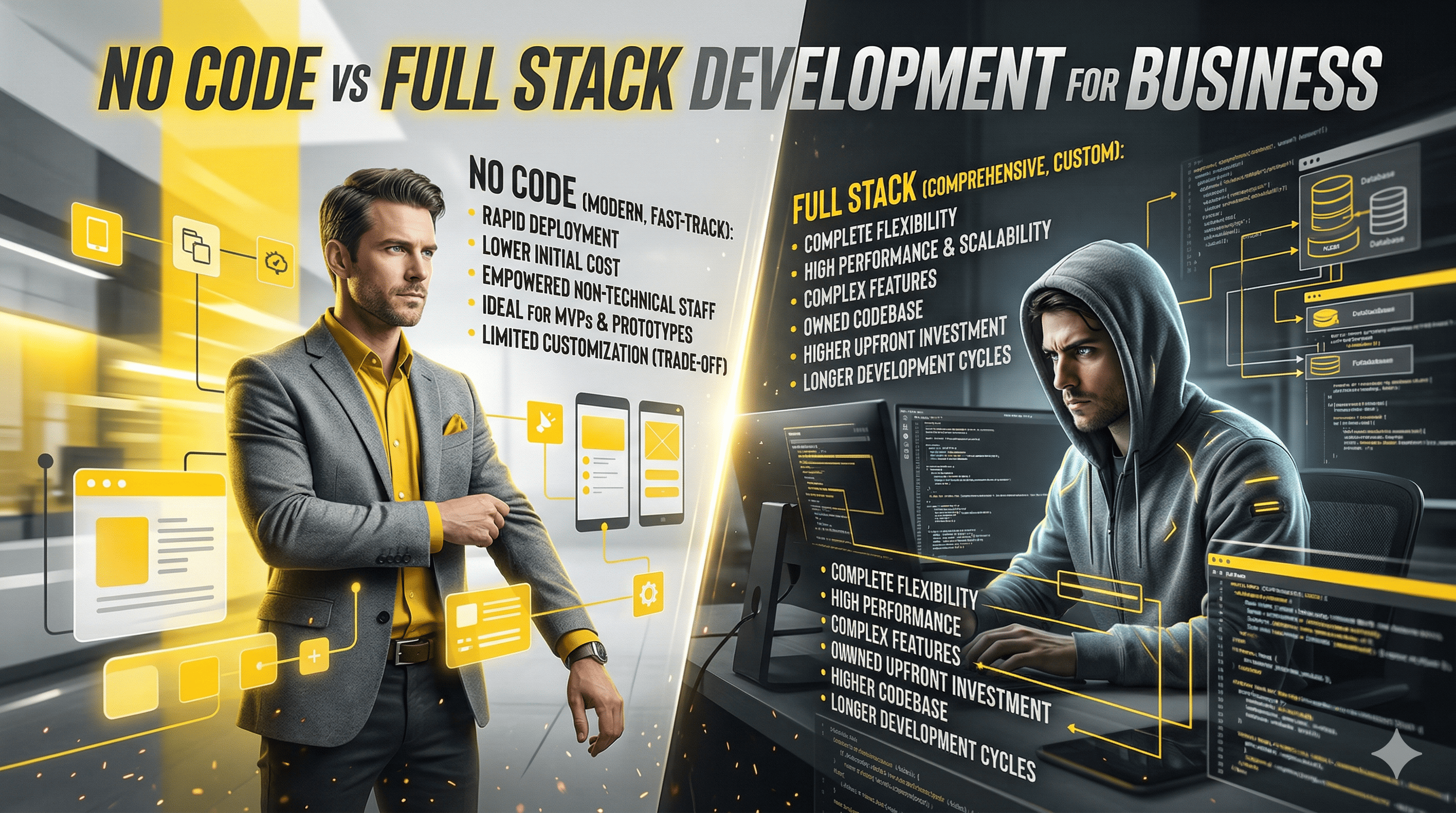
We wasted three years on no-code. Wix, Bubble, Webflow, Squarespace, GoDaddy—you name it, we dragged it and dropped it. And I'm a programmer. A full-stack engineer who should have known better. Yet I fell for the same trap that catches thousands of SMBs every month: the illusion of productivity.
Here's what I learned: No-code feels fast. It's not. It's procrastination wearing a template.
Here's the real-time of the growth graph from Feb'26 to Mar'26 as we implemented fullstack development.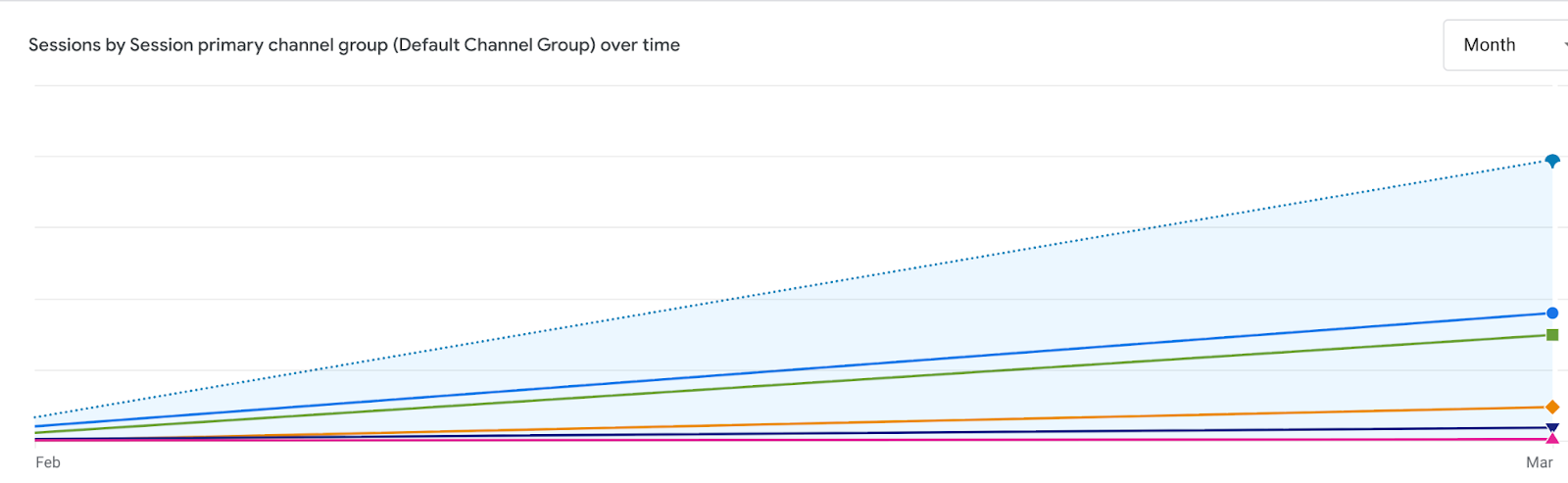
The No-Code Trap: Why Drag-and-Drop Is Really Just Renting Someone Else's Limits
When you build with no-code, you're not building a business. You're building inside a box.
The box feels roomy at first. Drag a hero section, drop some buttons, add a form, watch the magic happen. It's intoxicating. You feel productive. You feel like you're moving fast. You tell yourself: "Why would I spend months coding when I can ship in days?"
Here's the problem: the moment you outgrow the box, the box doesn't grow with you.
The Wall Hits in Three Predictable Places
1. Custom Logic Becomes Impossible
Want to integrate with a third-party API that the no-code platform doesn't officially support? Good luck. You'll spend three hours Googling workarounds, build a Zapier integration that's fragile and expensive, and pray it doesn't break on a Friday night.
We learned this with customer data integrations. What should have taken one developer two hours took our team five days of troubleshooting and jury-rigging webhooks.
2. Performance Degrades
No-code platforms optimize for the average case. They're not optimized for your specific use case. Page load times creep up. API response times bloat. Your site starts feeling sluggish. Users leave. Revenue drops.
We watched our conversion rate tank by 12% because a no-code site simply couldn't handle the traffic patterns we needed.
3. Scaling Becomes Expensive (Or Impossible)
Want to grow? No-code platforms charge you for every upgrade—more storage, more API calls, more users. A custom full-stack app? You pay for what you use. The ROI difference is gigantic.
The Turn: We Just Built It. And Everything Changed.
One day, we stopped. We said: "What if we just.. built it?"
So we did. From scratch. No template. No drag-and-drop. No platform limitations. Just code.
Here's what happened:
Speed: We went from weeks to hours. Instead of waiting for a platform update or finding a workaround, we just added the feature ourselves. Friday feature requests shipped by Monday.
Ownership: We owned the product. Not renting it from Wix or Bubble. Not at the mercy of their API changes or their pricing increases. We controlled the entire stack.
Scalability: We could handle 10x the traffic without renegotiating our bill. We could integrate with any platform we wanted. We could build features that competitors couldn't replicate because they were still trapped in no-code.
ROI: It was immediately obvious. The cost of building it real was paid back in saved platform fees and engineering time within months. Years later, the ROI is absolutely gigantic.
And here's the kicker: it has never been cheaper or easier to do this.
Why Now Is The Best Time To Build Full-Stack (And Why SMBs Keep Missing It)
The barrier to entry has collapsed.
Ten years ago: Building a full-stack app meant expensive servers, complex DevOps, hiring senior engineers, months of development.
Today: You've got:
Free or cheap hosting (Vercel, Railway, Render deploy for pennies)
Modern frameworks (Next.js, React, Vue—all free, all battle-tested)
Managed databases (Postgres, MongoDB, Supabase—MUCH cheaper than enterprise solutions)
Developer tools (GitHub, TypeScript, AI code assistants—democratizing expertise)
A small or medium business can now build and ship what took a whole engineering department a decade ago.
And yet most SMBs are still dragging and dropping on GoDaddy.
Why? Fear. And Lack of Knowledge.
Most business owners have been told: "You need a developer. Developers are expensive. No-code is the solution."
It's partially true. Developers are expensive. But:
You don't need a full-time team. A single good developer working 20 hours a week can build what takes a no-code platform months.
You don't need specialized DevOps expertise anymore. Modern platforms abstract away the complexity.
AI is changing the game. Tools like Claude and ChatGPT are making development faster and more accessible than ever.
The real cost isn't the developer. It's the time you spend renting someone else's platform and hitting walls.
The Business Case: Full-Stack vs No-Code (Real Numbers)
Let's talk money.
No-Code Path (3-Year Cost):
Platform fees: $100–$300/month ($3,600–$10,800)
Add-ons and integrations (Zapier, plugins): $200–$500/month ($7,200–$18,000)
Workarounds and band-aids: 200 hours of team time (~$15,000 at $75/hour)
Lost revenue from performance issues: $5,000–$20,000
Total: $30,600–$63,800 (+ headache + lost growth)
Full-Stack Path (3-Year Cost):
Developer time (contract): $40,000–$80,000 (80–160 hours @ $250–$500/hour)
Hosting: $500–$2,000/year ($1,500–$6,000)
Tools and services: $200–$500/year ($600–$1,500)
Total: $42,100–$87,500 (+ complete ownership + unlimited scaling)
On the surface, the costs look similar. But here's what you get for your money:
With no-code, you're renting forever. You'll be paying the fee every month, forever, with no end date and no ownership.
With full-stack, you're buying. After three years, you own a product that generates revenue. You can sell it, scale it, or pivot it. You own your data. You own your competitive advantage.
Who Should Build Full-Stack? (Hint: Probably You)
Not every business needs a custom full-stack app. But if any of these apply to you, you do:
 You're growing faster than your platform can handle You hit traffic spikes, performance tanks, or you're paying premium platform fees for growth.
You need custom integrations You want to sync data with tools that no-code doesn't officially support, or you need unique workflows that templates can't provide.
You're losing money to platform limitations Performance issues, missing features, or workarounds are costing you revenue or engineering time.
You want to own your competitive advantage Your product is becoming central to how you do business, and you need features and customization that competitors can't replicate.
You're planning to scale beyond a specific region or audience No-code gets expensive at scale. Full-stack gets cheaper.
If you checked even two of those boxes, full-stack is probably the right move.
How to Make The Transition (Without Killing Your Business)
The good news: you don't have to migrate everything overnight.
Phase 1: Start with one feature or product Don't rewrite your entire site. Build the next new thing in full-stack. Run both in parallel. Learn what works.
Phase 2: Hire or contract a developer A good full-stack developer is worth their weight in gold. Look for someone with experience in your industry, not just technical chops. Remote is fine—talent is distributed now.
Phase 3: Migrate gradually Move high-impact pages and features first. Keep things on no-code that don't need optimization. You can always migrate later.
Phase 4: Own it Once you've built it, your team owns it. Make sure they have the skills to maintain it. If not, invest in training.
The transition doesn't have to be painful. It just has to be intentional.
The Hard Truth: No-Code Is For Prototypes, Not Products
Here's my honest take: no-code is great for one thing—validating an idea quickly before you commit real resources.
Build a landing page in Webflow. Validate the concept. Get early users.
But the moment your business starts depending on it, the moment revenue is flowing through it, the moment performance matters—you need to own your stack.
We spent three years learning this the hard way. The ROI was gigantic once we switched. The speed, the ownership, the competitive advantage—it all clicked.
I'm ashamed it took us so long. I'm a programmer. I should have known better.
But here's what I'm telling you: stop waiting. The tools are free. The infrastructure is cheap. The barrier to entry is gone.
All that's left is the decision to own your destiny instead of renting someone else's.
Written by
Sachin Rajgire