Everyone has a resume length rule. One page. Two pages. Never more.
I've heard it all.
But after placing 850 candidates over five years, I can tell you the rule is wrong — and it's costing you interviews.
https://www.youtube.com/shorts/QIRmdSIErNg
The Problem: Why You're Cutting What Gets You Hired
Here's what I see over and over: candidates trimming their bullet points. Shrinking fonts. Cutting entire sections of experience just to hit some imaginary "one-page" limit.
Why? Because they've been told that hiring managers only read one page. That recruiters won't look at anything longer. That two pages screams "desperation."
The problem is this isn't true. And while you're obsessing over pages, you're actually removing the very things that would get you hired.
Think about it: A recruiter spends 6 seconds on your resume. Those 6 seconds aren't spent counting pages. They're spent asking three questions:
1. Did you actually do this job before?
2. Can you prove it with numbers?
3. Are you worth a phone call?
Page count doesn't answer any of those. Your content does.
The Solution: Express Yourself Ruthlessly
Here's what I've learned from 850 placements:
Stop thinking about pages. Start thinking about clarity.
Your resume should be whatever length you need to clearly express yourself — nothing more, nothing less.
One paragraph tells your story? Perfect. Ship it.
You need two pages to show your full scope? Use it.
You need 2.5 pages because you have 15+ years of relevant experience? Take it.
The length isn't the measure of success. The content is.
What Actually Matters:
Quantified Results
"Led a team of 8" beats "managed teams." Numbers stick.
Relevance to the Role
A 2-page resume full of what the job is looking for beats a 1-page resume full of noise.
Clarity of Impact
Can the recruiter understand what you did and why it mattered in under 6 seconds? If yes, length is irrelevant.
White Space
Tight, readable formatting matters more than squeezing more onto fewer pages.
The Framework: 3 Questions to Ask Yourself
Ask yourself three questions for each section of your resume:
1. Does this prove I can do the job I'm applying for? If yes, keep it. If no, cut it.
2. Can I back this up with a number or outcome? If yes, add it. If no, rewrite it to show impact.
3. Would a recruiter care about this in 6 seconds? If yes, keep it. If no, trim it.
That's it. Not pages. Impact.
Real Example from the Field
I had a candidate who was cutting her 2-page resume down to fit one page. She was removing entire projects because "it looked too long."
I told her: "Stop. Your last three projects are directly relevant to this role, and each one shows a different skill set. That's why they're there."
She kept the 2-page version and applied to 5 companies. She got 4 interviews.
The person she was competing with? One-page resume, generic bullets, no numbers. They got rejected by 3 out of 5 of those same companies.
Page length didn't matter. Clarity and relevance did.
What People Usually Get Wrong:
MYTH 1: "Hiring managers won't read past page one."
REALITY: Recruiters will read as much as they need to find what they're looking for. If your second page has the proof they need, they'll read it.
MYTH 2: "One page looks more professional."
REALITY: A cluttered, hard-to-read one-page resume looks unprofessional. A clean, organized two-page resume looks like you respect the reader's time.
MYTH 3: "I should cut my experience to fit one page."
REALITY: You should cut irrelevant experience. If the experience is relevant and you have space to express it clearly, keep it.
The Bottom Line
Your resume doesn't need permission to be two pages.
But it does need permission from you to be honest.
Are you trimming real experience just to hit a page count? Stop.
Are you cramming three lines into one sentence to save space? Stop.
Are you removing numbers because "it looks cluttered"? Stop.
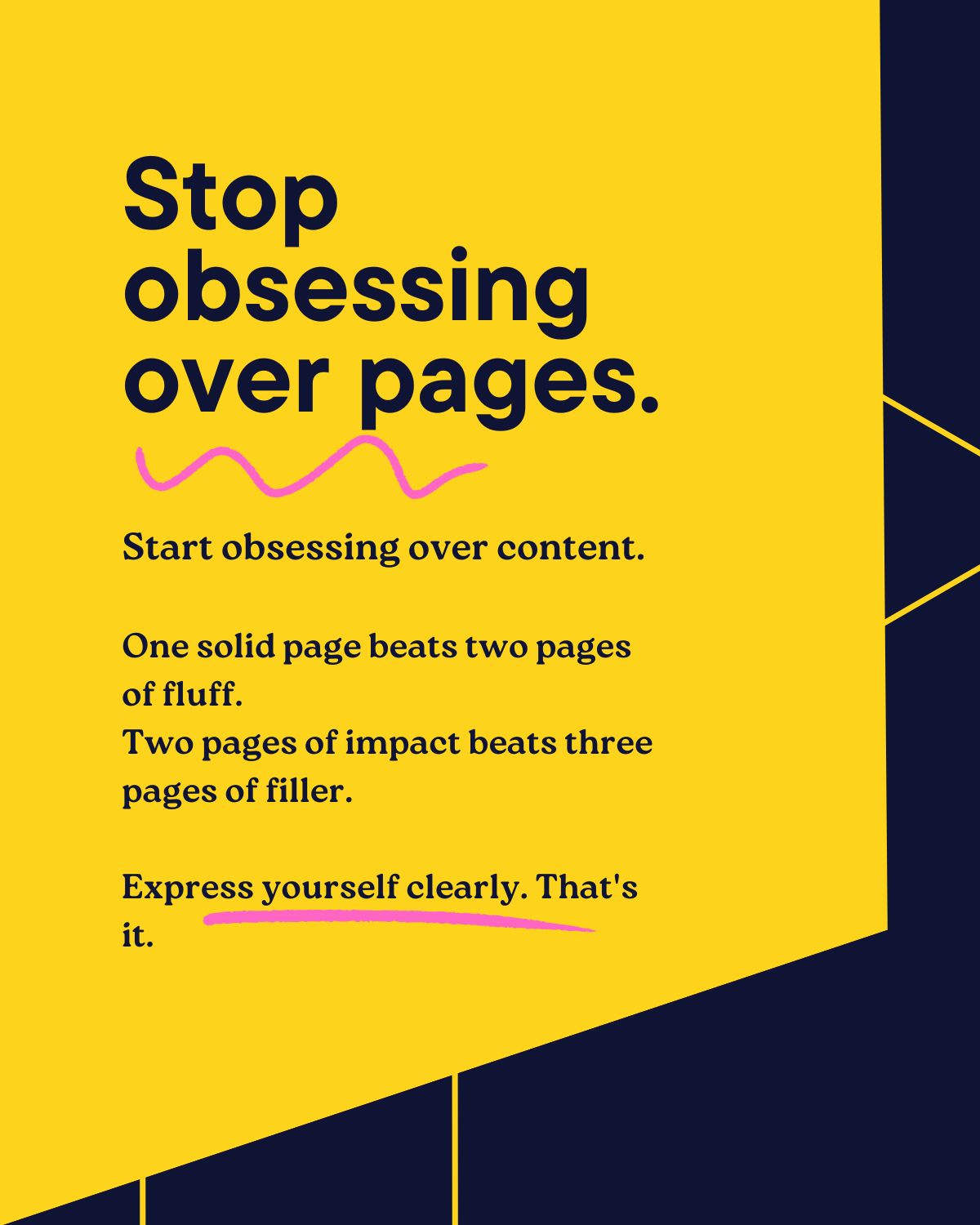
Express yourself clearly. One page of impact beats three pages of fluff. But two pages of impact beats one page of compromise every single time.
The hiring manager isn't counting your pages. They're looking for proof that you can do the job.
Give them that proof, in whatever format needs it.
Ready to Fix Your Resume?
We've helped 850+ candidates land interviews using this approach. Your resume isn't the problem. Your strategy is.
P.S. Reply to sachin@wynisco.com for this post with your biggest resume question. I read every single reply.
Written by
Sachin Rajgire