QUICK ANSWER — How to get an interview |
I've looked at this problem from both sides.
As a hiring consultant who has placed 850+ professionals in US jobs — visa holders, OPT students, career switchers, people with employment gaps — I've watched thousands of applications go nowhere. Not because the candidates were unqualified. Because their applications sent the wrong signal.
And before Wynisco, I was a Senior Engineer at PayPal and CNBC. I know what it feels like to sit across from a hiring manager and wonder why your resume didn't get you the call you deserved.
So when people ask me "how do I get an interview?" — I don't give them a generic checklist. I give them what I've seen actually work, across eight years and 850 real placements. This is that answer.
Why you're not getting interview calls (it's not what you think)
Most people assume they're not getting interviews because their resume isn't good enough, they're not experienced enough, or the market is too competitive.
Here's what's actually happening.
Recruiters are not reading your resume and deciding you're unqualified. They're not reading your resume at all — not yet. They're making a pre-decision, a 3-second judgment, before they ever open your file.
That pre-decision is based on one thing: signal strength. Does your application signal "this person is serious, specific, and relevant" — or does it signal "this person is spraying applications hoping something sticks"?
According to LinkedIn's Talent Solutions research, 87% of recruiters regularly use LinkedIn to source and vet candidates — which means your entire digital footprint is being evaluated before a single word of your resume is read.
Recruiters process hundreds of applications a week. They've developed an almost unconscious radar for generic applications. And when they sense it, they move on. You're not being rejected for being unqualified. You're being skipped for looking generic.
At Wynisco, I reviewed 47 application sets from candidates in our program last year. The ones who got callbacks in under three weeks didn't apply to more jobs. They applied to fewer — and sent stronger signals. That pattern repeats every single cohort.
The three filters every application passes through
Before a recruiter picks up the phone, your application clears three invisible filters. Most candidates fail at least one. The ones getting interviews pass all three.
Filter 1 — the robot filter (ATS)
Your resume gets scanned by software before a human sees it. According to Harvard Business Review research on modern hiring practices, more than 75% of resumes are rejected by automated tracking systems before a human ever sees them. If your resume doesn't contain the right keywords from the job description, it gets buried automatically.
Filter 2 — the 6-second human filter
A recruiter opens your resume. Their eyes move. In just six seconds, according to a TheLadders eye-tracking study, a recruiter decides whether you're worth the next 30 seconds or the delete key. They look at your most recent title, the company name, and one or two bullet points. That's it.
Most resumes fail this filter because they're written as career histories, not as role-specific arguments.
Filter 3 — the "why you" filter
This is the most overlooked filter and the one that determines whether you get the call. A recruiter has five decent resumes open. They're deciding who to contact. They don't pick the most qualified person. They pick the person who made contacting you feel obvious.
That feeling comes from specificity — from the sense that you want this job at this company, not just any job at any company. Generic applications fail this filter instantly.
The Interview Request Formula
Here's the formula, distilled from patterns tracked across 850+ placements at Wynisco:
The Formula |
Targeted Signal + Relevant Proof + Direct Ask = Interview Request |
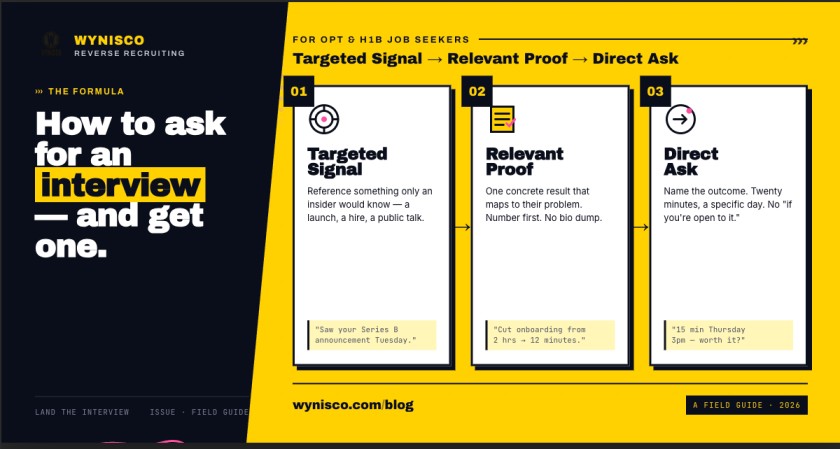
Component 1: targeted signal
A targeted signal is anything that tells the recruiter: "I did my homework on your company specifically." This shows up in three places.
Where it appears | How to write it |
In your outreach message | Instead of: "I'm interested in the PM role" Say: "I noticed your team launched a self-serve onboarding flow last quarter. I've built two of those from scratch — would love to talk." |
In your cover letter | Instead of: "I'm excited to apply" Say: "Your expansion into healthcare data caught my attention — I spent two years in health-tech and understand how hard compliance is." |
In your resume summary | Mirror the exact language from the job description. If their JD says 'cross-functional collaboration,' your summary should too. |
One specific detail does more work than three paragraphs of general enthusiasm.
Component 2: relevant proof
Relevant proof is not a list of your skills. It's a single, specific example that directly answers the recruiter's unspoken question: can this person actually do the job we need done?
The proof point formula |
"In my role at [Company], I [action] which resulted in [specific outcome] — directly relevant to what you're building." |
One sentence. One proof point. That is enough to get a call scheduled. Most candidates bury their best proof point on page two under a generic bullet. Pull it out. Put it in the first thing the recruiter reads.
Component 3: direct ask
This is the part almost nobody does. Most applications end with "I look forward to hearing from you." That's passive — it puts the entire burden on the recruiter to make something happen.
Instead, end with a specific, low-friction ask:
"Would you have 15 minutes this week for a quick call?"
"Happy to jump on a call at your convenience — Thursday or Friday works well for me."
"I'd love to share a few specific ideas for the role if you have 20 minutes."
You're not demanding anything. You're making it easy for them to say yes. A direct ask changes the recruiter's mental response from "I'll file this" to "I should respond to this."
What this looks like in real life
Wynisco placement story |
One candidate I worked with — a data analyst from Bengaluru, on OPT, three months of applications, zero callbacks — came to Wynisco convinced his resume was the problem. We spent 20 minutes on it. It was fine. The actual problem: he was applying to 60 jobs a week with the same resume and the same cover letter. His signal strength was zero. We cut his list to 12 companies. Rewrote his outreach for each one. Found the hiring manager at six of them and sent a three-line email with a specific proof point. Within 11 days he had four callbacks. Placed in 38 days at $97,000. Same resume. Different signal. Completely different result. |
How to apply the formula across every touchpoint
On a job application (resume summary)
Your resume summary — top of resume, 3–4 lines — should embed all three components:
Example resume summary |
"Data analyst with 4 years building revenue attribution models for B2B SaaS platforms. Reduced reporting time by 60% through automated dashboards at [Company]. Targeting growth-stage companies building in fintech — open to a conversation." |
Targeted signal (fintech, growth-stage) · Relevant proof (60% reporting reduction) · Direct ask (open to a conversation)
On a cold outreach email
Copy-paste outreach template |
Subject: Quick question re: [specific initiative they launched] Hi [Name], I noticed you launched [specific thing] last month. I did something similar at [Company] — improved [relevant metric] from X to Y. I've applied through your careers page but wanted to reach out directly. Would you have 15 minutes this week? [Your Name] |
When a recruiter sees your application alongside a note from the hiring manager, your interview rate jumps from roughly 3% to 20–40%. That's not an estimate — that's what we track at Wynisco across every placement.
On LinkedIn
When you connect with a hiring manager:
LinkedIn connection note |
"Hi [Name] — I just applied to the [Role] at [Company]. I led a similar function at [Your Company] and wanted to connect directly. Would love to hear more about what you're building." |
The mistake that kills your interview rate
There's one thing that breaks the formula every time: volume over targeting.
When you apply to 80 jobs in a week, you cannot personalise 80 applications. So you send the same resume, the same cover letter, and the same generic outreach to everyone. You become invisible.
Recruiters can feel the difference between someone who read the job description and someone who copy-pasted. They open five applications side by side and compare. The generic one never wins.
At Wynisco, we've seen candidates go from zero interviews on 60 applications to three callbacks in 10 days — by cutting their list to 15 targeted companies and applying the formula properly to each one.
The rule |
Fewer applications. More targeted. More results. |
If you've been applying for weeks with no response
If you've been applying for a month or more and getting nothing back, run this quick diagnostic:
Problem area | How to diagnose it |
Check your ATS score | Paste your resume and the job description into Jobscan. If you're scoring below 60%, keywords are your problem. |
Check your signal strength | Read your last five applications out loud. Does each one mention something specific about that company? If not, you're sending generic signals. |
Check your proof points | Are your bullets results-based or duty-based? "Responsible for managing social media" is a duty. "Grew LinkedIn engagement 3x in 90 days" is proof. |
Check your ask | Did your outreach end with a specific easy ask — or did it trail off into "looking forward to hearing from you"? |
If you've been at this for more than 60 days with no traction, the problem is usually structural. We do exactly that at Wynisco — apply here to work with us.
Frequently asked questions
Q1. How do I get an interview if I have no connections at the company?
Use LinkedIn to find the hiring manager directly and send a three-line message referencing something real about their team or a recent product launch. |
According to LinkedIn Talent Solutions data, cold outreach with a specific, researched signal consistently outperforms warm referrals with generic notes — we see this pattern confirmed across every cohort at Wynisco. Don't wait for an introduction. Make the connection yourself.
Q2. Why am I not getting job interviews even though I apply every day?
Volume without targeting is the single most common reason candidates apply for months and hear nothing back. Recruiters detect generic applications immediately. |
Cut your list to 15–20 targeted companies, apply the formula above to each one, and your response rate will shift — usually within two to three weeks. This is what we see at Wynisco every cohort without exception.
Q3. How long should I wait before following up on a job application?
Wait five business days before following up. One follow-up is appropriate and professional. A second after another five days if there's still no response. |
After two follow-ups with no response, move your energy to other companies on your target list. Persistence beyond two follow-ups reads as desperation, not enthusiasm.
Q4. Is a cover letter necessary to get an interview?
Not always — but a targeted cover letter becomes your biggest differentiator when your resume looks similar to other qualified candidates. |
A three-paragraph cover letter using the formula above — targeted signal, relevant proof, direct ask — will separate you from 80% of applicants. The targeted signal alone (one sentence showing genuine research) does the heavy lifting.
Q5. What's the fastest way to get a job interview?
Direct outreach to the hiring manager, combined with applying through the company's own careers page (not a job board), is consistently the fastest path to an interview callback. |
When a recruiter sees your resume alongside a note from the hiring manager saying "this person reached out to me directly," your interview rate jumps from roughly 3% to 20–40%. That's not an estimate — it's what we track at Wynisco across every placement.
A note from Sachin
I wrote this because I've watched too many qualified people disappear into the black hole of job board applications and never come out.
The formula isn't complicated. The problem is that most people don't believe it's this simple — so they keep doing what isn't working.
Try it on your next five applications. Not fifty. Five. See what changes.
If you want our team working alongside you on targeting, outreach, interview prep, and direct hiring manager connections — Wynisco is here. We've placed 850+ professionals. Average 52 days. 78% success rate. We don't get paid until you do.
Written by
Sachin Rajgire